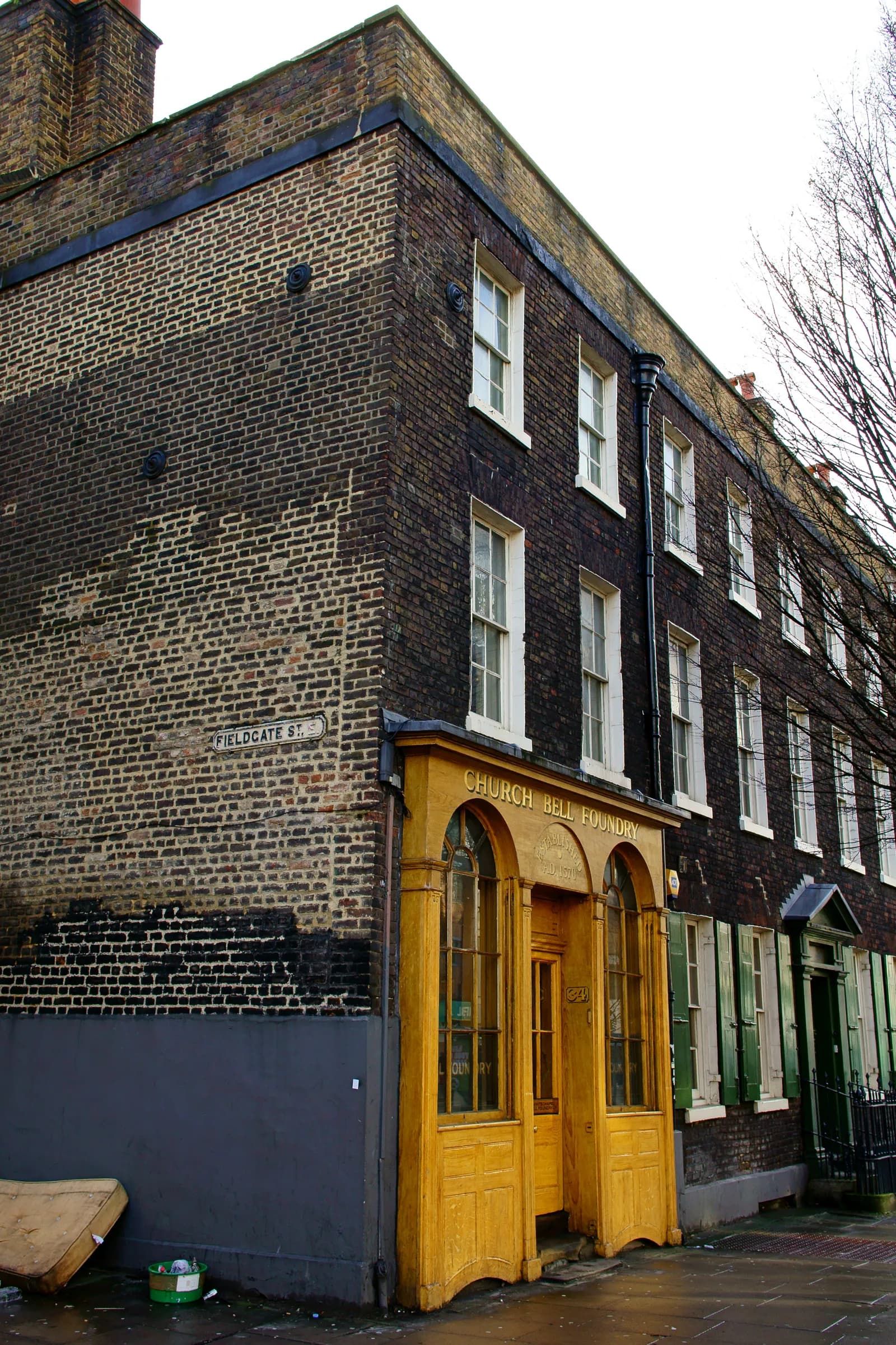
The Whitechapel Bell Foundry stood at 32–34 Whitechapel Road for more than two centuries as Britain's oldest manufacturing company. From this unassuming East End premises came the bells that rang out for American independence, marked time at Westminster, and tolled across five continents.
Five Centuries of Craftsmanship in Tower Hamlets
Bell founding in the Whitechapel area traces to 1360, with master founders recorded from 1420. The business that became the Whitechapel Bell Foundry dates its foundation to 1570, during the reign of Elizabeth I. The company moved to its Whitechapel Road site in approximately 1739, where it would remain for nearly 250 years. The foundry earned recognition in the Guinness Book of Records as Britain's oldest manufacturer.
The Hughes family owned the foundry from 1904, when Arthur Hughes purchased it from the widow of Robert Stainbank. In December 2016, Alan and Kathryn Hughes announced their decision to sell, citing what they described as "changing realities of running a business of this kind." Soaring property prices in Whitechapel had made the Grade II* listed site increasingly difficult to sustain as a working foundry.
The final bell was cast on 22 March 2017. The foundry closed its doors on 12 June 2017, ending 446 years of continuous production.
The Liberty Bell: Cast in Whitechapel, Cracked in Philadelphia
In 1752, the foundry then operated by Lester and Pack received a commission that would secure its place in American history. The bell, costing £150 13s 8d (equivalent to approximately £28,000 today), was intended to celebrate the 50th anniversary of William Penn's 1701 Charter of Privileges.
The bell bore an inscription from Leviticus 25:10: "Proclaim LIBERTY Throughout all the Land unto all the Inhabitants Thereof." Weighing 2,080 pounds (940 kg), it arrived in Philadelphia in August 1752. It cracked upon its first ringing. Local founders Pass and Stow recast it twice before the bell achieved its eventual form.
Despite its imperfection, the cracked bell became an enduring symbol of American independence. It remains on display in Philadelphia, still bearing its Whitechapel origins.
Big Ben: The Foundry's Most Famous Recasting
The foundry's most renowned work came in 1858, when it recast the Great Bell for the new clock tower at Westminster. The original bell, cast by John Warner & Sons of Stockton-on-Tees in 1856 and weighing 16 tons, had cracked during testing.
Whitechapel Bell Foundry produced a replacement weighing 13.5 long tons (13.7 tonnes), the largest bell ever cast on the premises. The final bill came to £572. The bell first rang on 31 May 1859. It cracked soon after, reportedly due to a hammer that was too heavy. The crack was never repaired; it gives the bell its distinctive tone to this day.
The template used to cast Big Ben's profile remained mounted around the entrance door at the foundry. The original moulding gauge was retained near the furnaces.
Bells That Rang Across the World
The foundry produced bells for St Paul's Cathedral, Westminster Abbey, and Canterbury Cathedral. It cast the heaviest change-ringing peal in the world for Liverpool Cathedral between 1924 and 1942. Washington National Cathedral received bells in 1962. Guildford Cathedral, Bow Church, and Lincoln Cathedral all contain Whitechapel bells.
More recent commissions included the Olympic Bell for the 2012 London Games, though at 23 tonnes it proved too large for the Whitechapel furnaces and was cast in the Netherlands to Whitechapel designs. The Royal Jubilee Bells for the Thames Diamond Jubilee Pageant followed the same year. In 2001, the foundry produced the Bell of Hope, a memorial to the 9/11 attacks, which is rung annually at 08:46 in New York.
War Years and Post-War Recovery
During the Second World War, the foundry served as a munitions production line for the War Office. In the aftermath, business surged as the foundry replaced bells damaged during the Blitz. The loam moulding technique used at Whitechapel remained essentially unchanged for centuries.
An Uncertain Future
The building at 32–34 Whitechapel Road, backing onto Plumbers Row, stands as a Grade II* listed structure. In 2017, Raycliff Capital purchased the site for £7.9 million. Tower Hamlets Council approved a proposal for a 100 to 108-room hotel with a bell-themed café in November 2019. The Secretary of State called in the application in January 2020, though it received final approval in May 2021.
The last bell cast at Whitechapel, along with historical artefacts, now resides at the Museum of London. A bell makers' memorial wall preserved inside the foundry recorded the site's history. The foundry's patents were sold to Whites of Appleton in Oxfordshire, ending a 197-year business relationship. Tower bell production rights passed to the Westley Group Ltd, whilst hand bells and presentation bells continue under Bells of Whitechapel Ltd.
In November 2022, the London Bell Foundry made an offer to purchase the site with the intention of returning bell casting to Whitechapel. The building currently remains vacant.
What Is Confirmed
The Whitechapel Bell Foundry operated from 1570 to 2017. It cast the Liberty Bell in 1752 and recast Big Ben in 1858. The building at 32–34 Whitechapel Road is Grade II* listed. It closed on 12 June 2017.
What Is Unclear
The exact date the foundry moved to Whitechapel Road is disputed between sources; 1738, 1739, and the mid-1740s are all cited. The precise founding date of the business is also uncertain, with claims ranging from 1567 to 1574. The future use of the site remains unresolved despite planning approval for hotel development.